When Institutions Mistake Survival for Disorder:
The Untold Crisis Facing PTSD Survivors, First Responders, and Whistleblowers’
© 2025 — Samantha Syrnich (TLC)
⸻
Op-Ed by Samantha Syrnich (TLC)
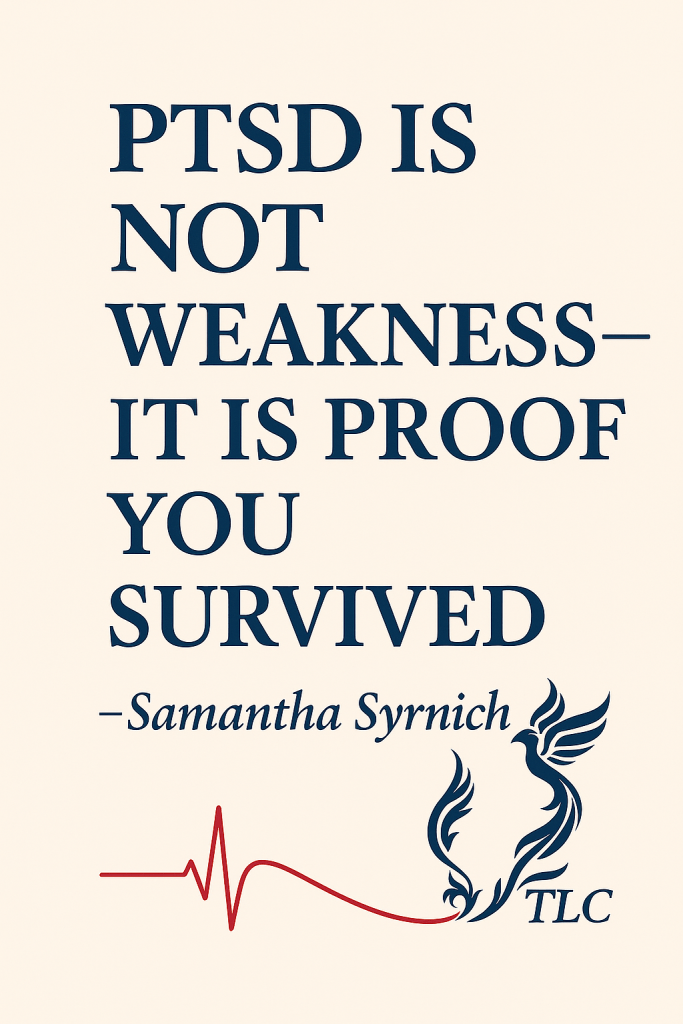
The greatest threat to a trauma survivor is not always the person who hurt them.
Sometimes the most dangerous blow comes later—from the institutions sworn to protect them.
We live in a country where surviving can be used as evidence against you, where physiological trauma responses are mistaken for instability, and where the very agencies built on “service and protection” quietly retaliate against those who once served inside them. This includes former law enforcement officers, military personnel, EMTs, and federal employees whose careers exposed them to violence, crisis, and ethical conflicts that the public rarely sees.
The public is told that PTSD is a “mental health condition.”
What they are not told is that PTSD is also a paper trail—a living archive of the misconduct, negligence, systemic failures, and, in some cases, retaliation that inflicted or worsened the trauma.
The PTSD survivor becomes the evidence of the crimes committed against them.
And institutions know it.
Which is why so many of them work hard to silence, discredit, institutionalize, or destabilize the people they once trained.
⸻
I. The First Responder’s Burden: Trauma With No Safe Harbor
Former officers, veterans, paramedics, dispatchers, and federal agents carry a kind of trauma that traditional systems are entirely unprepared to treat. They are trained to handle crisis, not to explain it—especially not to civilians who lack the vocabulary, the physiological understanding, or the cultural competence to assess what they are seeing.
For these professionals:
• removing clothing—even for a medical exam or shower—can take extraordinary psychological effort
• hypervigilance is not anxiety
• scanning exits is not paranoia
• rigid posture is not defiance
• silence is not disconnection
• emotional neutrality is not “flat affect”
• avoiding hospitals is not “noncompliance”—it is self-protection
These are not behavioral choices.
These are conditioned survival instincts forged in repeated exposure to violence, betrayal, and high-stakes duty.
Yet when these same individuals seek help after their service ends, many report being mocked, dismissed, labeled, and medically abandoned by the institutions they thought they could trust.
They face a second trauma:
Retaliation for having survived the first.
⸻
II. When DCRs and Hospitals Misinterpret the Physiology of PTSD
One of the most alarming trends emerging in the United States is the misuse of Designated Crisis Responders (DCRs) against former first responders and whistleblowers—often during medical, not psychiatric, emergencies.
A PTSD “psychotic break” is not what people believe it is.
In most cases, what institutions call “psychosis” is a neurophysiological overload where:
• cortisol floods the bloodstream
• the hypothalamic-pituitary-adrenal (HPA) axis collapses
• adrenaline spikes disproportionately to the trigger
• memory retrieval and executive function temporarily fail
• the limbic system overrides rational thought
• thyroid hormones destabilize
• blood pressure fluctuates
• inflammatory cytokines surge
• dissociation or shutdown occurs
This is a body under siege, not a mind in madness.
When humiliation or institutional hostility is added—such as unnecessary breathalyzers, accusatory questioning, restraints, or public shaming—the physiological overload intensifies. The survivor’s body responds as though they are under attack, because in many ways, they are.
Yet many hospitals respond by:
• dismissing autoimmune symptoms
• diagnosing “weakness” instead of endocrine collapse
• forcing psychiatric evaluations instead of running thyroid labs
• withholding fluids, pain control, or nausea management
• calling DCRs instead of physicians
• treating trauma responses as behavior problems
• ignoring the patient’s training, history, and medical documentation
This is not trauma-informed care.
It is institutionalized retraumatization.
And it disproportionately affects former law enforcement, military veterans, EMTs, and whistleblowers because their calm under duress is misread as emotional stability… until the body can no longer compensate.
When the crash hits—especially in conditions like Hashimoto’s, where the thyroid is under autoimmune attack—it can resemble intoxication, exhaustion, or psychiatric distress.
But it is none of those things.
It is biology.
It is inflammation.
It is endocrine failure.
It is a medical emergency.
And when it is caused or worsened by retaliation, neglect, or political/county-level pressure, the autoimmune assault becomes a civil rights violation, not a fluke of nature.
⸻
III. The Retaliatory Machine: What Officers and Whistleblowers Must Know
There is a hard truth no one warns you about when you work inside federal, state, or county systems:
Your employer may retaliate against you long after you leave.
If your story threatens their image—
If your whistleblowing exposes wrongdoing—
If your records implicate someone with influence—
—you may become a target.
Many former officers and federal employees report patterns consistent with interagency retaliation, including:
• coordinated harassment
• former colleagues showing up in court matters involving family
• denial of whistleblower protections
• misdirection designed to keep you too busy to document abuses
• sudden financial destabilization
• unjustified welfare or guardianship interventions
• medical interference
• discrediting diagnoses
• forced psychiatric labels
• delay or denial of essential medications
• actions intended to provoke homelessness, isolation, or despair
The goal is strategic:
break the survivor before they can expose the truth.
If the survivor becomes impoverished, houseless, debilitated by autoimmune crashes, or mislabeled with stigmatizing diagnoses, their testimony loses power. Their credibility is undermined. Their trauma becomes a tool used against them.
This is how institutions erase the evidence of what they’ve done.
They break the witness—and then point to the brokenness as proof the witness was never credible.
This is why so many whistleblowers, disabled ex-LEOs, and former federal employees end up fighting every day just to stay alive, write their reports, or get someone—anyone—to listen.
⸻
IV. The Physiology of Being Broken Down
The public imagines PTSD as nightmares and flashbacks.
The real damage is far more complex.
Long-term institutional retaliation and medical neglect cause:
• cortisol dysregulation
• thyroid destruction
• adrenal fatigue
• histamine storms
• chronic inflammation
• sleep-cycle collapse
• gastrointestinal dysfunction
• cognitive fog
• muscle weakness
• sensory hypersensitivity
• autoimmune flares
• panic episodes mistaken for psychosis
• dissociative shutdowns mistaken for defiance
This is why removing clothing—even just to shower—can feel impossible.
The body associates vulnerability with danger.
Yet once the shower is complete, the body often feels momentarily restored—a temporary reprieve from the internal war zone.
This contrast is its own kind of torture.
⸻
V. The Hazing Culture No One Talks About
Ex-law enforcement officers often describe being treated as a liability, not a colleague, once they leave the agency—especially if the separation was contentious or whistleblower-related.
They experience:
• hazing by former interagency coworkers
• mockery about their trauma symptoms
• exaggerated or fabricated concerns about “mental health”
• unauthorized information sharing
• surveillance or intimidation
• interference with medical care or housing stability
These acts are not random.
They are cultural.
Law enforcement culture punishes those who speak even the slightest truth about internal misconduct. The same is true in DHS, certain military chains, and county-level agencies with insular power structures.
When a former officer becomes disabled, or when autoimmune disease emerges due to stress and trauma exposure, institutions often see an opportunity to push the individual into invisibility.
If you are busy trying to survive—
if you’re fighting homelessness—
if your body is collapsing—
if you are constantly recovering from crises—
—you have less capacity to write reports, file claims, expose corruption, or pursue legal remedy.
This is by design.
⸻
VI. The Future Unknown: What Trauma Survivors Live With Every Day
The hardest part for many survivors is not the past.
It is the constant uncertainty of what their body will do next, how institutions will respond, or whether retaliation will escalate.
Every day becomes:
• a negotiation with your own physiology
• a calculation of risk
• a battle to obtain correct medication
• a fear of being misdiagnosed again
• a question of whether today is the day an agency decides to “intervene”
• a hope that someone in DHS will read the letters you keep writing
• a prayer that your existence will finally matter more than their convenience
Survivors exist in a suspended state between vigilance and exhaustion.
Yet they keep fighting.
They keep writing.
They keep documenting.
Not because they want revenge, but because they want truth.
⸻
VII. What America Must Do Now
For federal policymakers, legislators, DHS leadership, medical institutions, and county systems, the mandate is clear:
If you want to protect survivors—and especially first responders—you must:
• overhaul DCR protocols
• mandate advanced trauma physiology training
• recognize autoimmune-triggered crises as medical emergencies
• forbid retaliation through psychiatric mislabeling
• protect whistleblowers without loopholes
• establish third-party oversight for county agencies
• end interagency targeting
• require trauma specialists in all emergency rooms
• ensure disability accommodations are honored without question
America cannot claim to value veterans, officers, or whistleblowers if its institutions destroy them the moment they seek help.
PTSD is not a liability.
It is documentation.
It is biological testimony that trauma occurred—
and sometimes, testimony that a system tried to break the person who refused to stay silent.
The truth is simple:
PTSD is not weakness.
It is proof you survived what others didn’t want exposed.
And survival should never be treated as a threat.
© 2025 — Written by Samantha Syrnich (TLC)
All rights reserved

 The Phoenix Quill: Words Born of Fire, Inked in Truth